
Dynamic QR Platform
Create QR codes Instantly
Website URL
Send users to any webpage
Website URL
Website URL
Send users to any webpage
Wi-Fi
Let users connect instantly
Wi-Fi
Wi-Fi
Let users connect instantly
Menu
Create a digital menu
Menu
Menu
Create a digital menu
Start a chat with one tap
Start a chat with one tap
Image
Showcase visuals
Image
Image
Showcase visuals
Show a downloadable file
Show a downloadable file
27 Sep 2026 • 13 min read
Tyre Digital Product Passports and QR Codes: Preparing for the EU's 2027 ESPR Work
A tyre-specific guide to preparing product identity, QR code placement and lifecycle data for prospective EU Digital Product Passport requirements.
IntroductionWhat a tyre Digital Product Passport could need to connectWhy a QR code is a practical tyre DPP data carrierTyre lifecycle data to organize before requirements are finalThe hard part: physical QR code placement and durabilityMake the passport accessible before the tyre is purchasedA practical 2026 preparation checklistCommon mistakes to avoidStart with a tyre-specific pilot, not a full portfolio rolloutFAQ
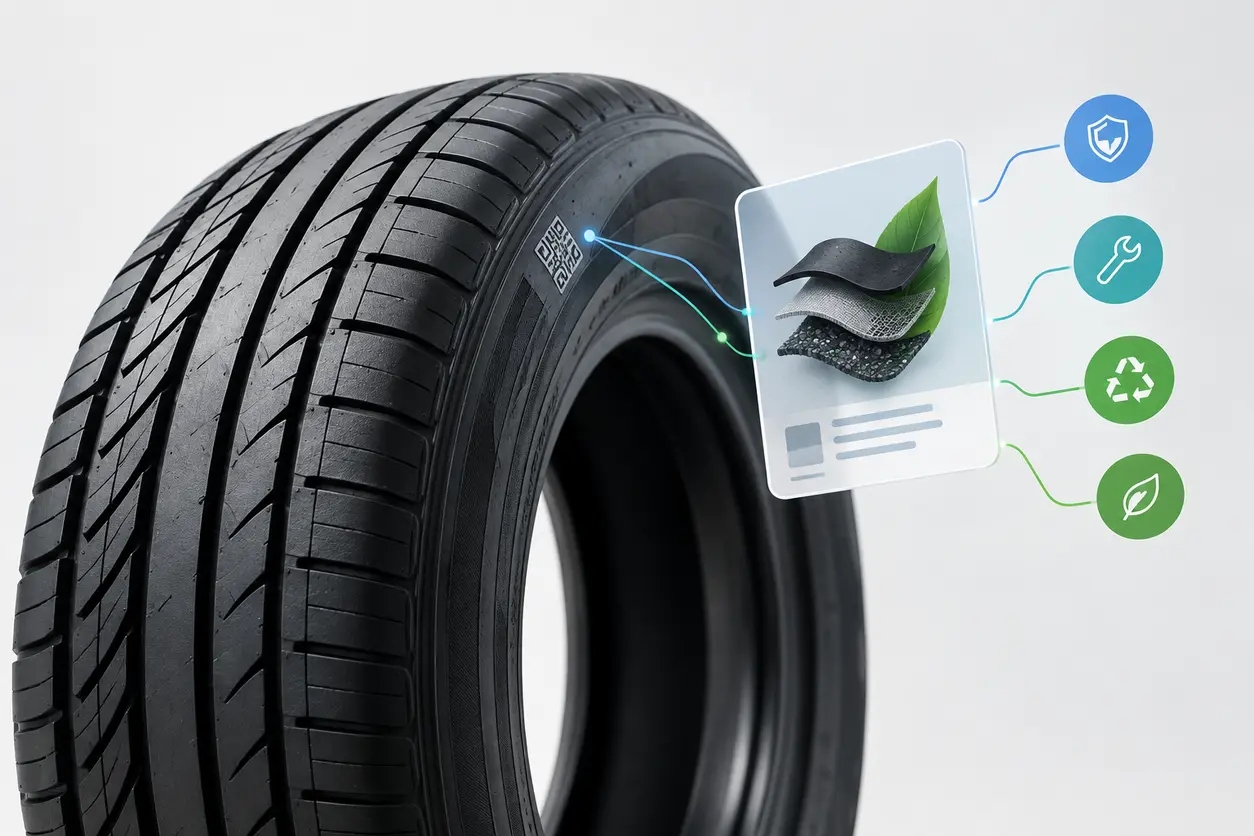
A tyre digital product passport QR code is not simply a consumer-facing link added to a sidewall. It is a physical-to-digital access point for a product record that may need to remain useful through distribution, fitting, service, retreading or reuse pathways, and end-of-life handling.
For tyre manufacturers, importers, distributors and fleet suppliers, the sensible task in 2026 is preparation rather than declaring compliance. The EU's Digital Product Passport work is progressing under the Ecodesign for Sustainable Products Regulation (ESPR), but the product-specific delegated act will determine the final requirements for tyres. The European Commission's economic-operator guidance for Digital Product Passports identifies tyres in an indicative 2027 timeline. The Commission's live DPP Registry announcement also includes tyres among the ESPR product groups supported by the Registry.
That makes this a good time to solve the operational questions that take longest: how to assign a persistent identity, connect records across systems, select an appropriate data carrier, and make a code survive a tyre's real-world journey.
Important: this article discusses a preparation approach. It does not state final legal obligations for tyres. Tyre-specific data fields, identifier rules, carrier format, placement, access rights and timing remain provisional until the applicable EU measures are adopted.
What a tyre Digital Product Passport could need to connect
At its core, a Digital Product Passport (DPP) is an accessible digital record associated with a product. For a tyre, the record must make sense to more than one audience over a long and demanding lifecycle:
- A manufacturer needs a reliable link to the production and technical record.
- A distributor needs accurate product identification and catalog information.
- A dealer or fitter may need fitting, handling and service-relevant guidance.
- A fleet operator may need an asset-level connection to inspections, rotations, repairs and casing history.
- A reuse, retread or recycling operator may need composition, material and treatment information.
- A consumer may need clear, suitable product information before and after purchase.
- Regulators may need defined access to the fields eventually required by law.
This is why a simple SKU page is not a complete tyre DPP strategy. It may be one destination or presentation layer, but the underlying model needs durable product identity, data stewardship and controlled updates.
Product-model identity versus individual-tyre identity
Start by separating two levels of identification.
Product-model identity identifies the tyre specification sold as a product: for example, a named range in a particular size, load index, speed rating and construction. It can connect to shared documents, performance declarations, material information and approved product-level instructions.
Individual-tyre identity identifies one physical tyre or, where applicable, an identifiable production unit. It can connect to batch, manufacturing, quality, warranty, service, repair, retread or end-of-life records.
The final tyre rules may specify which level is required for particular DPP functions. Preparing both concepts now prevents a common mistake: using a product-page URL as though it were a permanent, unique identity for every tyre.
Why a QR code is a practical tyre DPP data carrier
A QR code is one possible data carrier that can take a person from a physical product or related touchpoint to the passport experience. It is familiar to smartphone users, supports a compact encoded destination and can be scanned without a dedicated reader in many situations.
For a tyre digital product passport QR code, the code should not carry a large passport dataset inside the symbol. Instead, it should resolve to a managed web address or landing route that finds the relevant passport record. This keeps the physical mark compact and lets the digital destination be maintained as approved data evolves.
A well-designed route can use a stable identifier to return the right experience for the right user. For example:
- A consumer scans a code on a display card and sees product-level information suitable for purchase and ownership.
- A workshop scans an authorised service label and reaches technical or service documentation.
- An approved recovery or recycling partner reaches end-of-life data appropriate to its role.
- A compliance team can maintain a controlled record without replacing every physical code when a non-identity document or page layout changes.
A QR code is not automatically a DPP solution. The code, identifier, resolver, product-data system, access controls and governance process must work together.
Persistent does not mean permanently frozen
The identity tied to the tyre should remain stable. The content delivered through that identity may need controlled updates.
For example, a corrected recycling instruction, revised safety notice, new language version or updated repair guidance may need to be published after a tyre is manufactured. A dynamic destination gives the organization a way to update the approved content without changing a printed display label or a code already applied to packaging.
Do not use editability as a reason to overwrite historical facts. Establish clear ownership rules:
- Preserve the original manufacturing and batch facts.
- Version documents and record when a version becomes effective.
- Keep an audit trail for material changes where your governance process requires it.
- Define who can approve destination changes.
- Ensure a retired product still resolves to an informative status page rather than a broken link.
Tyre lifecycle data to organize before requirements are final
Tyre-specific delegated rules will ultimately define the required data. Until then, a practical preparation program maps data that already exists, identifies gaps and distinguishes controlled facts from marketing content.
Material and composition information
A tyre contains multiple materials and components, and composition information is rarely owned by one department. Procurement, material engineering, formulation teams, sustainability teams and suppliers may each hold part of the picture.
Build a data map that identifies:
- Which material or substance data is held internally and which comes from suppliers.
- The level of detail that can be disclosed externally, shared only with authorised parties or retained internally.
- The product or batch scope of each record.
- Units, versions, source systems and responsible data owners.
- How substitutions and formulation changes are handled over time.
The point is not to publish every internal formulation detail in a public QR landing page. It is to be able to locate governed information and apply access rules when final requirements clarify who needs which data.
Durability, performance and use context
Tyre durability is not a one-number field. Product performance can depend on the product specification, vehicle fitment, axle position, inflation, load, driving environment, maintenance and operating conditions.
Prepare a structured model that keeps approved product claims separate from operational service records. At product level, this may include technical specifications, intended-use categories, approved documentation and product version information. At an individual or fleet asset level, it may include inspection records, tread-depth readings, repair events, rotations or removals—if your business has a lawful and practical reason to manage that information.
Avoid presenting an estimated service life as a universal guarantee. The DPP destination should clearly separate manufacturer-controlled product information from records created by a fleet, dealer or service provider.
Repair, reuse and retreading pathways
A tyre's circularity story is physical, not just digital. Information may need to help qualified operators determine whether a casing is suitable for assessment, repair, reuse or retreading under applicable technical and safety processes.
Preparation questions include:
- Can a service event be linked to the correct tyre without confusing product model and individual unit?
- Is there an agreed status vocabulary for inspected, repaired, retreaded, withdrawn or recovered?
- Who is permitted to create or amend service records?
- Are photos, inspection documents or work orders held in the correct system and linked with suitable permissions?
- What happens to the digital record when a tyre changes owner or is exported?
Do not imply that a QR scan authorises a repair or retread. Suitability decisions must remain with qualified operators and applicable procedures.
Recycling and recovery information
At end of life, recovery partners benefit from reliable identification and information that supports safe, efficient handling. A tyre passport strategy can make it easier to locate approved recovery documentation, composition-related information where relevant and instructions for escalation when a product cannot be identified.
Design for imperfect conditions. A worn sidewall may be dirty, damaged or inaccessible. A recovery workflow should have a fallback based on readable human text, an alternative identifier, packaging or commercial records rather than relying entirely on one scannable symbol.
The hard part: physical QR code placement and durability
Tyres expose marks to abrasion, flexing, contamination, moisture, temperature change, ultraviolet exposure and inconsistent scanning angles. A QR code that scans perfectly from a flat package proof may fail on a curved, dirty sidewall after real handling.
This is where a tyre-specific strategy differs from generic DPP advice.
Sidewall marking
A sidewall is attractive because it stays with the product after packaging is discarded. It is also the most challenging option. Sidewall geometry, contrast, texture, mold process, local placement restrictions, cosmetic requirements and wear all affect scan reliability.
Before selecting sidewall placement, test representative tyres rather than only artwork files. Test new tyres, dirtied samples, wet samples, tyres under varied lighting and samples viewed at realistic scan distances. Include common phone cameras, not only industrial scanners.
Questions for engineering and quality teams:
- Does the marking remain visually distinct across rubber compounds and finishes?
- Can the chosen process reproduce modules cleanly and consistently?
- Does local curvature distort camera capture at the intended code size?
- Can the code be located without requiring a user to crawl under a vehicle or rotate a mounted wheel excessively?
- Does the symbol remain usable after normal storage, transport, fitting and service handling?
Packaging and labels
Packaging offers a clean, flat surface and can work well for distribution, warehouse and point-of-sale workflows. It may be ideal for a product-level code on a retail label, pallet label, wrap or carton.
Its limitation is lifecycle persistence. Packaging may be removed before installation, and a barcode on a label can be separated from the physical tyre. Treat packaging as a useful access point, not necessarily the only access point.
A practical approach may use multiple routes to the same controlled passport record: a packaging code for sale and logistics, a durable product mark where feasible, and an online product-page link for pre-purchase access. Whether multiple carriers will be required or permitted in a particular configuration will depend on final rules.
Dealer, fleet and service labels
An additional workshop or fleet label can help operational teams access a service view without placing every workflow on the tyre itself. This can be useful for mounted-wheel, depot or inspection processes. It also introduces governance risk: the label must be securely associated with the correct tyre and should not replace the authoritative identity.
Make the passport accessible before the tyre is purchased
A tyre is frequently researched online before it is seen in person. A physical QR code on the product cannot be the only route to relevant information if a shopper, procurement team or fleet buyer is comparing options from a desktop, marketplace or distributor catalog.
Create an online-access pattern that mirrors the physical code's destination:
- Put a visible passport or product-information link on the manufacturer product page.
- Include a structured passport link in distributor catalog data where commercial arrangements allow.
- Use the same controlled product identity across the listing, technical documents and physical carrier.
- Ensure the page works without requiring an app, login or QR scan for information intended to be publicly accessible.
- Test the path on mobile and desktop, including localized versions.
The online presentation should not become a generic marketing landing page. Put essential product identity near the top, show the scope of the record and separate public information from authenticated service or business-partner content.
A practical 2026 preparation checklist
Use the following checklist to move from broad DPP awareness to an implementation-ready tyre data and code strategy.
1. Establish a cross-functional owner group
Include product engineering, regulatory, sustainability, IT/data, packaging or molding engineering, quality, aftermarket/service, e-commerce and legal teams. Nominate one accountable lead for decisions and a data owner for each record category.
2. Create a tyre data inventory
List data elements already held for each product range, where they live, their source, version, owner, update frequency and disclosure constraints. Include supplier-provided material records and downstream documents held by service networks.
3. Define the identity hierarchy
Document the relationship between product family, specification, SKU, production batch and individual tyre or casing where applicable. Decide which IDs are immutable and which are commercial labels that can change.
4. Design a minimum viable passport record
Build an internal prototype with information you can substantiate today. Include a clear product identity, a document versioning model, a contact or escalation route and a retired-product response. Do not wait for every future field to start testing the architecture.
5. Run physical carrier trials
Test QR code candidates on the actual media under realistic scanning conditions. Compare molded or marked tyre locations, packaging labels and service labels. Record failures, not just successful scans, and involve fitters or warehouse staff in usability testing.
6. Choose dynamic destination governance
Use a managed destination for content that can legitimately change. With QR Rapid, teams can create branded QR codes for pilot packaging, dealer materials and internal test labels, then update a destination during development without recreating every code. Keep the persistent product identifier and your controlled product-data system as the source of truth; the QR code should route to that governed experience.
7. Build online parity
Make the same product-level information findable from product pages and catalog feeds before purchase. Test that the online link leads to the same current record as the QR code.
8. Plan operating procedures for exceptions
Define what happens when a scan fails, a code is damaged, a tyre cannot be identified, a record is disputed or a product is withdrawn. Give dealers, support teams and recovery partners a documented fallback process.
9. Monitor the delegated-act process
Track official updates and reassess your design when tyre-specific rules clarify the data carrier, identity, access and data requirements. The Commission's DPP economic-operator information is a useful official starting point for following the wider framework.
Common mistakes to avoid
Treating a marketing QR code as the passport
A campaign code with a short-term landing page, tracking parameters and no controlled product identity is not a durable passport architecture. Marketing can sit alongside the DPP experience, but do not make it the only route.
Printing a code before defining the identifier
A visually excellent QR code still fails the traceability objective if it points to an ambiguous or changeable product record. Set the identity model first, then determine what the code resolves to.
Putting all data in public view
Different users may need different detail. Design public, authenticated and controlled-access layers rather than exposing commercially sensitive or operational records by default.
Assuming packaging solves lifetime access
Packaging codes are valuable, but they may leave the tyre long before inspection, replacement or recovery. Plan a resilient access model and a human-readable fallback.
Waiting for final rules before doing anything
Final legal details matter, but data cleanup, ownership, identifier mapping, website integration and physical marking trials take time. Preparatory work reduces the risk of a rushed, disconnected rollout later.
Start with a tyre-specific pilot, not a full portfolio rollout
Choose one tyre family with manageable data, an active distribution route and access to real-world scan testing. Map the identity hierarchy, build a controlled product record, publish a limited online view and trial QR codes on the intended physical media.
Use the pilot to answer practical questions: Can a technician find the code? Does it scan on a dusty tyre? Does the online record match the distributor listing? Can your team correct an approved document without changing the product identity? Is there a reliable fallback when a code cannot be read?
QR Rapid can support the test-and-learn part of this work by helping teams generate, customize and manage pilot QR destinations across packaging, dealer materials and internal service workflows. The strategic goal is not more scans for their own sake. It is a dependable bridge between a tyre's physical identity and an accurate, governed lifecycle record—ready to adapt when EU tyre-specific DPP requirements are finalized.
FAQ
Are tyres definitely required to have Digital Product Passports in 2027?
No final tyre-specific obligation should be assumed from an indicative timeline. Commission guidance identifies tyres in an indicative 2027 timeframe, but the applicable delegated act will set final requirements, scope and dates.
Does a tyre Digital Product Passport have to use a QR code?
Final tyre-specific rules will determine the required or accepted data carrier approach. A QR code is a practical preparation option because it can connect a physical tyre, label or package to a managed digital record.
Should the QR code be molded into the tyre sidewall?
Possibly, but not automatically. A sidewall mark can remain with the tyre after packaging is removed, yet it must be tested for contrast, curvature, abrasion, dirt, lighting and scan accessibility. Packaging and service labels can provide additional access points.
What data should tyre manufacturers prepare first?
Start with a controlled product identity, specification and technical-document mapping, material-data ownership, version history, approved durability-related information, and repair, reuse, retread or recovery data pathways where relevant.
Can a dynamic QR code be used for a tyre passport pilot?
Yes. A dynamic destination can allow approved information pages to be updated without reprinting pilot codes. The underlying product identifier should remain stable, and governance should prevent changes to historical manufacturing facts.
How can tyre information be accessed before an online purchase?
Publish a clear passport or product-information link on manufacturer product pages and, where possible, in distributor catalog data. The pre-purchase route should lead to the same controlled product-level record as the physical QR code.
Similar Blogs
The latest industry news, interviews, technologies, and resources.
 September 26, 2026
Digital Product Passports for Online Marketplaces: Pre-Purchase Data-Carrier Delivery
Digital Product Passports for Online Marketplaces: Pre-Purchase Data-Carrier Delivery
Read post
 September 15, 2026
Expiry Dates, Lot Numbers and Recalls in 2D Barcodes: What GS1's 2027 Shift Enables
Expiry Dates, Lot Numbers and Recalls in 2D Barcodes: What GS1's 2027 Shift Enables
Read post

Join 2,000+ subscribers
Stay in the loop with everything you need to know.
We care about your data in our privacy policy