
Dynamic QR Platform
Create QR codes Instantly
Website URL
Send users to any webpage
Website URL
Website URL
Send users to any webpage
Wi-Fi
Let users connect instantly
Wi-Fi
Wi-Fi
Let users connect instantly
Menu
Create a digital menu
Menu
Menu
Create a digital menu
Start a chat with one tap
Start a chat with one tap
Image
Showcase visuals
Image
Image
Showcase visuals
Show a downloadable file
Show a downloadable file
25 Oct 2026 • 11 min read
Digital Labels for EU Fertilising Products: QR/Data-Carrier Requirements Before 2027
A practical preparation guide to Regulation (EU) 2024/2516 for fertiliser manufacturers, importers and packaging teams, covering digital-label eligibility, physical data carriers, accessibility, privacy and long-term availability.
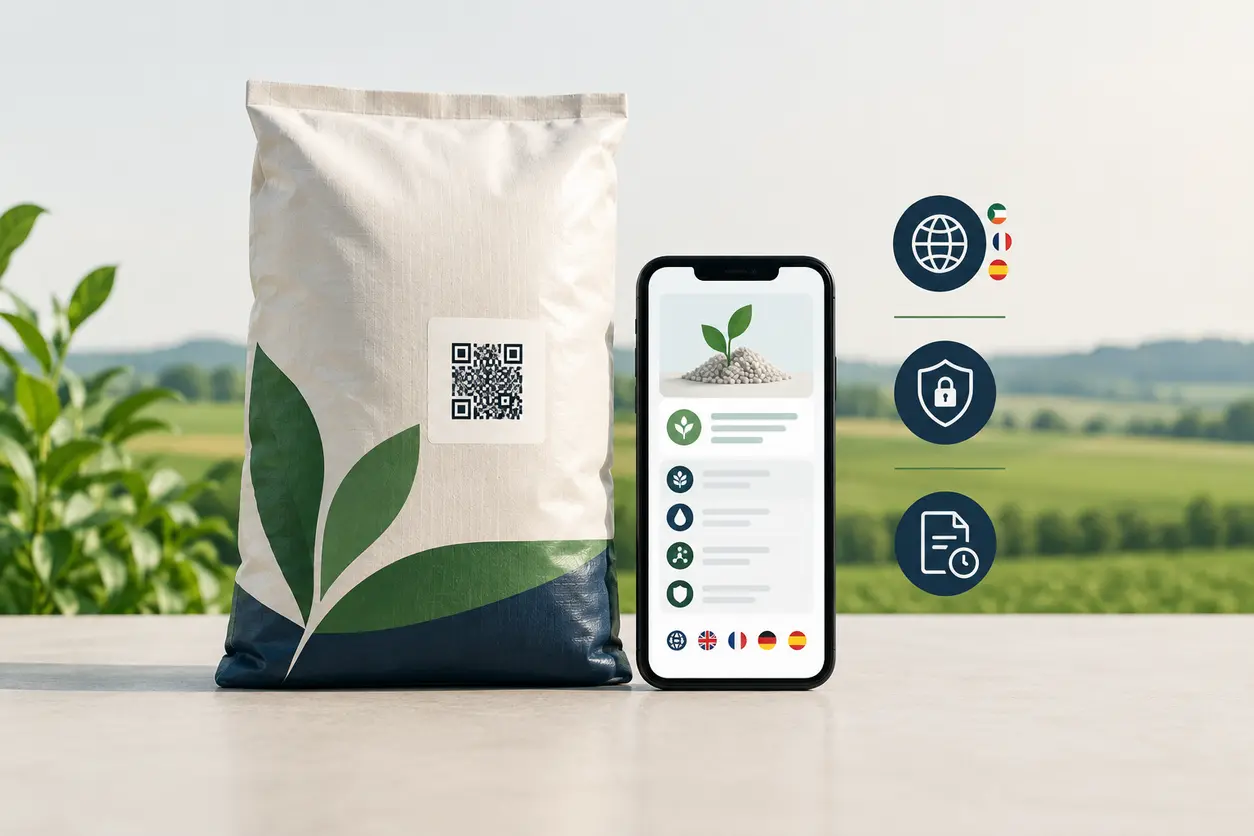
IntroductionWhat Regulation (EU) 2024/2516 changesWhen can fertilising-product labels be digital?The data carrier must exist physically—and work in practiceMake access free, direct and independent of an accountPlan multilingual access and vulnerable-user accessibilityPrivacy: do not reuse the marketing QR playbookTen-year availability requires an operating planWhat is due by May 2027?A practical QR Rapid pilot before packaging rolloutFAQ
For teams researching fertilizer digital label QR code EU requirements, the starting point is Regulation (EU) 2024/2516. It amends the EU Fertilising Products Regulation to introduce an optional digital-labelling framework, with different arrangements for supply-chain recipients and end users. It is not permission to remove every printed fertiliser label. The amending regulation sets out those distinctions and applies from 1 May 2027.
This guide explains what manufacturers, importers, agricultural suppliers and packaging teams should prepare before then: an eligibility decision, a physically usable data carrier, an accessible label destination and a long-term operating model—not a marketing tracking funnel.
What Regulation (EU) 2024/2516 changes
The regulation introduces digital-labelling provisions into Regulation (EU) 2019/1009 for EU fertilising products. Its framework addresses both where labelling information may appear and how an electronic label must work. Digital labelling is an option, not a universal requirement to replace physical labels. See the amendments to Article 11 and the new Articles 11a and 11b.
Start by confirming that the product falls within this EU fertilising-product framework. Do not assume that a national fertiliser, a crop-protection product or another agricultural chemical follows the same digital-label route simply because it is sold through the same distributor.
For implementation, split the project into two decisions:
- Regulatory allocation: which information must remain physical for this product and supply route?
- Technical delivery: how will the authorised digital information remain reachable and usable?
QR Rapid can help with creating the QR code that connects packaging to your chosen label destination. It does not make the underlying label legally complete or determine whether printed information can be removed. Regulatory approval must precede artwork approval.
When can fertilising-product labels be digital?
The important distinction is not simply “B2B versus consumer.” An agricultural business can be an end user when it buys fertiliser for its own application. Classify the recipient's role in the transaction rather than relying on whether the buyer has a business account.
Supply to economic operators that are not end users
For EU fertilising products made available to economic operators that are not end users, the framework allows the relevant labelling elements to be supplied digitally, physically, or in both forms. This is the broader digital-only opportunity within the supply chain. Article 11 distinguishes these recipients from end users.
For example, a manufacturer supplying a distributor should document that distribution role. If the same product is also supplied directly to farms for use, do not automatically apply the distributor's labelling arrangement to those deliveries.
Packaged products supplied to end users
For packaged products supplied to end users, digital labelling does not generally replace the physical label. Where both formats are used, the physical label must retain the required information except for the elements specifically identified in Annex III as eligible for digital-only presentation. The amended Article 11 and Annex III establish this limited exception.
Build a field-by-field allocation rather than a general instruction to “move technical details online.” For every label element, record:
- The applicable Annex III provision.
- Whether it must remain physical.
- Whether it is eligible for digital-only presentation.
- The approved wording and translations.
- The person responsible for approving its placement.
This becomes the working reference for artwork, web publishing and distributor instructions.
Products supplied without packaging to end users
Unpackaged supply has a different arrangement. Digital labelling is possible, but the framework also requires label information to be provided in a physical format in a visible place at the point of sale. Do not interpret this route as “a QR code somewhere on the premises is sufficient.” The regulation expressly addresses unpackaged end-user supply and point-of-sale information.
For a bulk agricultural supplier, the preparation task therefore includes the sales location and handover process, not just the manufacturer's digital page. Confirm who maintains the physical information when products, formulations or language requirements change.
The data carrier must exist physically—and work in practice
A digital destination does not remove the need for a physical access mechanism. The regulation requires the data carrier to be physically present in the relevant location, visible and legible, and readable by commonly used digital devices. For packaged products, its placement must also support access from outside the packaging. Article 11a sets out the data-carrier requirements.
A QR code is a practical way to provide that access, but the law's language is about a data carrier rather than a blanket mandate to use one particular QR product.
Test the actual fertiliser packaging
A code that scans from a designer's monitor is not an approved production result. Test the printed carrier on the real substrate and filled package.
Useful checks include:
- Does a crease distort the code when the sack is full?
- Is it covered by a pallet wrap overlap or a handling label?
- Does glossy material reflect light into the phone camera?
- Can users reach the carrier without opening the package?
- Does the print remain usable after ordinary handling?
- Can several commonly used phones open the destination without specialist equipment?
These are recommended acceptance tests, not prescribed measurements from the regulation. Agree on pass criteria with packaging and quality teams and retain photographs of approved placements.
Use a clear nearby instruction identifying the digital label. Avoid placing several visually similar codes together without explaining which one opens regulatory information.
Make access free, direct and independent of an account
The digital label must be accessible free of charge, without requiring registration, an application download or a password. It must not become a gated customer-service portal. These access conditions appear in Article 11a.
The intended journey should be simple: scan, open the label, select a language if necessary, and read the information.
Common implementation failures include a distributor login, an email form before document access, or a mobile page that only offers an app-store button. A free account is still an account requirement; removing the payment does not remove the access barrier.
Test access using a fresh browser session on a phone that has never visited your website. Repeat the test without accepting optional cookies. Check every redirect, not just the final label page. A direct public page can still be undermined by an intermediate service that adds a gate.
Keep the label clearly distinguishable from promotional content. A user looking for application instructions should not have to navigate product offers or choose a dealer before reaching the regulated information. The regulation also requires clear presentation and separation from other information.
Plan multilingual access and vulnerable-user accessibility
Digital labelling must respect the applicable language requirements. The framework also addresses usability for vulnerable groups and people with disabilities. A digital label is not compliant merely because its PDF technically downloads. Article 11a covers language availability and accessibility.
Build language coverage into the product record
Create a market-to-language checklist for each product. Have regulatory staff confirm the languages needed in the Member States where it is made available; do not assume that English alone is sufficient or that every product needs every EU language.
On the destination page, make the language selector easy to find. Display language names in a recognisable form and preserve the selected product when switching languages. Sending users back to a corporate homepage creates unnecessary work and increases the risk of selecting a different formulation.
Maintain one approval record linking the physical label, digital label and translated versions. If application guidance changes, the publishing process should identify every affected language before release.
Design for more than an ideal smartphone user
Practical accessibility measures include selectable text, clear headings, strong contrast, zoom-friendly layouts and meaningful link labels. Avoid making a photograph of a densely printed label the only available format.
Test screen-reader navigation and text enlargement. Ensure essential information is not conveyed only through colour or an unexplained icon. If offering a PDF, check its reading order and text accessibility rather than assuming that a downloadable file is automatically usable.
The regulation also provides for alternative access, including supplying digital-label information by alternative means on request and free of charge. Build that request-handling process into customer support rather than treating it as an exceptional favour. See Article 11b on economic operators' obligations.
Privacy: do not reuse the marketing QR playbook
Fertiliser digital labels are a poor fit for a default campaign-analytics setup. The regulation restricts tracking, analysing or using usage information beyond what is absolutely necessary to provide the digital labelling online. It also restricts personal-data processing beyond what is necessary to make the digital label accessible. Article 11a establishes these specific limits.
That is a different objective from measuring advertising performance. Do not assume that a consent banner makes a marketing-oriented label journey appropriate.
Audit the whole delivery chain
Review each component between the scan and the displayed information:
- The URL encoded in the QR symbol.
- Any redirect or short-link service.
- Hosting and content-delivery services.
- Website analytics and tag managers.
- Embedded video, fonts or third-party widgets.
- Access logs, identifiers and retention settings.
Ask each provider what it collects, why collection is necessary, how long data remains and whether processing can be disabled or minimised. A clean landing page does not resolve unnecessary tracking in the redirect layer.
For QR Rapid, choose the implementation only after checking the proposed code type and destination path against those requirements. Do not assume that a dynamic redirect or analytics configuration is suitable simply because it is useful for ordinary packaging campaigns.
Prefer operational checks that do not depend on profiling readers: scheduled destination checks, controlled scan tests and publication audits. Have privacy and legal staff assess necessary technical logging separately; “no marketing analytics” is a useful starting point, not a complete legal assessment.
Ten-year availability requires an operating plan
The digital label must remain available for 10 years from the time the EU fertilising product is placed on the market. This is a service-continuity obligation, not merely a promise that the QR image will not change. Article 11a specifies the availability period.
A readable QR code can still fail if its domain expires, a subscription ends, a file is deleted or a website migration breaks the path.
Assign ownership beyond the launch date
Document responsibility for:
- Domain renewal and destination hosting.
- Provider renewals and account access.
- Backups and restoration testing.
- Link checks and incident escalation.
- Product withdrawal or discontinuation handling.
- Migration if a provider or platform changes.
Connect the retention plan to placing-on-the-market records. Do not start a single countdown when the artwork is first approved and assume that it covers every later unit carrying that code.
Preserve identity when information changes
Use a destination structure that identifies the correct product and, where necessary, the relevant version. Do not recycle an old label URL for a different fertiliser.
Keep approved historical content and change records internally. If a product has materially different versions, decide how a reader scanning an older package will reach the appropriate information. A permanent URL that always displays an unrelated current formulation is not a successful continuity strategy.
These controls are recommended implementation practices. They help turn the legal availability requirement into something the business can actually maintain.
What is due by May 2027?
The regulation requires the Commission to adopt delegated acts by 1 May 2027 supplementing the digital-labelling requirements, including technical conditions and accessibility-related matters. The amending regulation itself also applies from 1 May 2027. The delegated-rule mandate and application date are set out in Regulation (EU) 2024/2516.
Treat that date as a regulatory checkpoint, not evidence that every technical implementation detail is already settled. This guide explains the supplied amending regulation; it does not establish whether subsequent delegated acts have been adopted or what their final specifications contain.
You can prepare now without locking in an inflexible solution:
- Classify products and recipient routes.
- Map physical versus digital information.
- Prepare approved multilingual content.
- Prototype accessible, ungated destinations.
- Audit privacy across the delivery chain.
- Establish continuity ownership and records.
- Recheck applicable delegated rules before approving production artwork.
A practical QR Rapid pilot before packaging rollout
Choose one representative fertilising product rather than converting the whole catalogue at once. For example, use a packaged product sold through distributors to agricultural end users. This exposes the important distinction between the intermediate supply-chain transaction and the final end-user label.
First, let regulatory staff approve the information allocation. Next, build a public label destination with the correct product identity, languages and accessible content. Then use QR Rapid to create a QR code pointing to the approved destination, checking the delivery configuration rather than assuming any tracking features belong in this workflow.
Print a production-style sample. Have packaging staff test placement, customer support test alternative information requests, privacy staff inspect network requests, and quality staff verify that the code opens the approved content. Record failures and retest after corrections.
Release only when the team can answer four questions confidently: Is the right information still physical? Can users reach the digital label without barriers? Is data processing limited appropriately? Who will keep this destination working throughout the required period?
Start with the label architecture, then create the code in QR Rapid. The strongest preparation for 2027 is not a more elaborate QR design. It is a reliable connection between the fertilising product, its approved information and the people who need to read it.
FAQ
Can every EU fertiliser replace its printed label with a QR code?
No. Regulation (EU) 2024/2516 distinguishes supply to non-end-user economic operators, packaged end-user products and unpackaged end-user products. Packaged end-user products must retain required physical information except for specified elements eligible for digital-only presentation.
Is a farm buying fertiliser automatically a non-end-user B2B recipient?
No. A farm buying fertiliser for its own application is an end user even though it is a business. Classify the recipient's role in the transaction, not just its commercial status.
Can a fertiliser digital label require a free customer account?
No. The digital-label access requirements exclude registration, passwords and required application downloads. A free account still creates a prohibited registration barrier.
Can scan analytics be used on an EU fertiliser digital label?
Do not assume ordinary marketing analytics are permitted. The regulation restricts tracking and usage analysis beyond what is absolutely necessary to provide the digital label online. Review redirects, hosting, embedded services and logging as well as the label page.
When does the 10-year digital-label availability period begin?
The regulation ties it to when the EU fertilising product is placed on the market, not when the QR code is created. Link continuity planning to placing-on-the-market records and account for later units using the same code.
What should teams check before the May 2027 rollout?
Check the Commission's delegated rules alongside the amending regulation before final artwork approval. Confirm information allocation, physical carrier placement, language coverage, accessibility, privacy controls and long-term destination ownership.
Similar Blogs
The latest industry news, interviews, technologies, and resources.
 October 24, 2026
Electronic Instructions for Medical Devices: Where QR Codes Fit After the EU's eIFU Expansion
Electronic Instructions for Medical Devices: Where QR Codes Fit After the EU's eIFU Expansion
Read post

Join 2,000+ subscribers
Stay in the loop with everything you need to know.
We care about your data in our privacy policy