
Dynamic QR Platform
Create QR codes Instantly
Website URL
Send users to any webpage
Website URL
Website URL
Send users to any webpage
Wi-Fi
Let users connect instantly
Wi-Fi
Wi-Fi
Let users connect instantly
Menu
Create a digital menu
Menu
Menu
Create a digital menu
Start a chat with one tap
Start a chat with one tap
Image
Showcase visuals
Image
Image
Showcase visuals
Show a downloadable file
Show a downloadable file
04 Oct 2026 • 12 min read
Textile Digital Product Passports and QR Codes: What Fashion Brands Should Prepare for Now
A fashion-specific readiness guide to garment QR placement, passport data, stable redirects, online access and supplier change management ahead of emerging EU textile DPP requirements.
IntroductionUnderstand the timeline without turning it into a blanket deadlineSeparate the garment identity, QR code and passport recordBuild a garment data model before designing the labelPlan QR placement around the garment's lifeUse stable routing instead of seasonal product URLsConnect in-store scans and online point-of-sale accessMake supplier changes part of the publishing processWhat to prepare in 2026: a fashion readiness checklistMistakes to avoid before scalingStart with a garment access pilot, not a compliance promiseFAQ
The immediate goal is readiness, not a premature claim of compliance. The European Commission identifies textiles and apparel as a priority category with an indicative 2027 timeline and describes passport access online and through a product data carrier such as a QR code. See the Commission's textile and apparel DPP overview. Final textile-specific delegated-act requirements are still being defined, so teams should separate confirmed direction from implementation choices that remain open.
This guide focuses on what fashion brands, apparel manufacturers, textile suppliers, e-commerce teams, sustainability teams and EU importers can prepare in 2026: durable garment access, flexible routing, evidence-backed data and a release process that can adapt when the final requirements become clearer.
Understand the timeline without turning it into a blanket deadline
The indicative 2027 milestone is a planning signal. It should not be presented as proof that every garment must carry a compliant passport from the first day of that year. Use the Commission's textile category guidance to monitor the direction, then check the eventual delegated act for product scope, required information, implementation dates and transition arrangements.
The July 2026 registry milestone is also relevant to implementation planning. The supplied Commission announcement on the DPP Registry launch provides a separate development to track. Registry infrastructure and textile-specific obligations are different subjects: a registry announcement should not be treated as a universal clothing compliance deadline.
Organize your readiness work into three categories:
- Direction to plan around: a product-linked passport, a physical access route and online access.
- Details to confirm: exact fields, identifier granularity, permitted carrier placement, access rights and retention requirements.
- Useful work regardless of the final specification: cleaner composition records, controlled product identifiers, tested label samples and accountable publishing workflows.
Assign regulatory monitoring to a named owner. Ask that person to report changes in terms of operational consequences: which supplier fields change, which artwork needs review and which systems need adjustment.
Separate the garment identity, QR code and passport record
A workable architecture has three distinct parts.
The product identity determines which garment or product grouping the information describes. Your current systems may distinguish style, colour, size, production batch and individual unit. Do not assume the final textile passport will use the same level as your marketing catalogue.
The QR code carries an access address. It is the doorway, not the complete passport. Generating a QR code does not establish that the underlying information meets regulatory requirements.
The passport record holds the structured data, evidence references and relevant public information. A readable webpage can be useful for shoppers, but a webpage alone should not be assumed to satisfy every future technical requirement.
For a pilot, document how these parts connect. Record the internal garment identifier, proposed passport identifier, encoded destination, label artwork version and responsible data owner. Keep these mappings separate from seasonal campaign names.
QR Rapid can help create QR codes for approved pilot destinations. Treat that as the access-layer task. Passport data governance, any registry integration and legal assessment require their own systems and review; do not assume a QR generator provides them.
Build a garment data model before designing the label
The Commission's textile and apparel overview is the starting point for following the category's development. The following fields are practical preparation candidates, not a definitive list of legally required textile passport data.
Fibre and component composition
Start with the garment's actual construction. A jacket can have different materials in the outer fabric, lining, insulation, pocket bags, zip tape and trims. A single whole-product statement may conceal distinctions needed for repair or recycling.
For each component, collect:
- Component name and internal material reference.
- Fibre composition and the source of that information.
- Supplier and applicable production batch.
- Relevant finishes, coatings or treatments where information is available.
- Evidence status, approval date and any unresolved discrepancy.
For example, a supplier substitution might affect the lining without changing the style name. Your workflow needs to detect that change before an existing passport page is reused for new production.
Sustainability and durability information
Keep claims attached to evidence. If you prepare recycled-content information, certification references, durability results or environmental assessments, record what each document covers and which product version it supports.
Avoid turning missing data into reassuring language. Internally, distinguish verified, supplier-declared, under review and unavailable information. Those are preparation statuses, not proposed regulatory classifications.
For test results, preserve the method, scope and document reference alongside the result. A durability statement without context is difficult to maintain when fabric weight, finish or construction changes.
Repair and recycling information
Prepare information that someone can use after purchase. For a coat, that might include zip replacement guidance, lining repair instructions and identification of detachable components. For knitwear, it might include mending guidance appropriate to the construction.
Recycling information should be specific to the garment and realistic about local options. Do not promise that a blended fabric can enter every textile collection stream. Where destination-specific guidance is necessary, distinguish the material description from local collection advice.
Keep instructions available independently of sales copy. A discontinued jacket can still need repair even when its campaign and product listing have been removed.
Plan QR placement around the garment's life
Carrier placement remains a specification to confirm against the final rules. In the meantime, test placement options rather than committing your entire label supply chain to an unverified assumption.
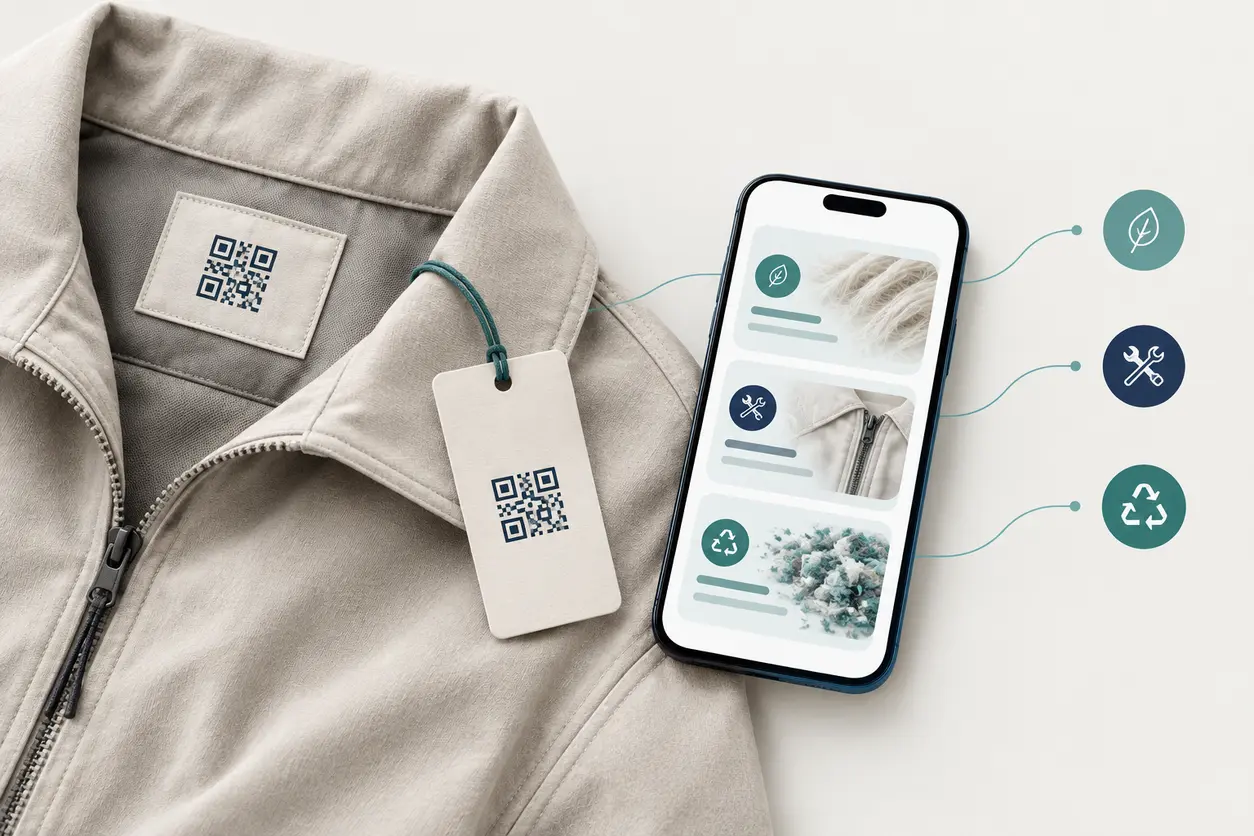
Sewn-in labels: useful for post-purchase access
A sewn-in label is a sensible pilot candidate because it stays associated with the garment during use. Evaluate whether customers can find it and flatten it sufficiently to scan.
Test the actual label substrate and printing process. Woven texture, ink spread, folds, seams and abrasion can affect readability. A code that scans from a screen or artwork proof has not yet passed a garment test.
Keep the QR symbol clear of stitching, folds and adjacent graphics. Preserve a clean surrounding margin and strong contrast. Add a short purpose statement, such as product information and repair guidance, without implying certified compliance.
Hangtags: useful at purchase, removable afterwards
A hangtag offers space and visibility in store. It is a good place to test shopper understanding, but it is usually removed after purchase. Do not rely on it alone for a workflow intended to support repair and end-of-life information.
Where a pilot uses both a hangtag and sewn-in label, ensure they resolve to the same product identity. Two separately managed destinations can drift apart when a supplier record changes.
Packaging: a supporting access point
Polybag stickers, cartons and other packaging can provide additional access during fulfilment or purchase. They also introduce mismatch risks: a garment can be repacked, returned or separated from its original bag.
Have packaging teams verify the garment-to-label association, not just the artwork. Do not assume a packaging-only code will meet the eventual textile requirements.
Retain existing physical information while assessing future rules. Do not remove composition, care or other established label content on the assumption that a digital page automatically replaces it; have the responsible compliance team review any proposed change.
Use stable routing instead of seasonal product URLs
A printed code can remain on a garment longer than an e-commerce platform or seasonal URL structure remains in use. Build the access route around continuity.
A practical pilot architecture is:
- The QR code encodes a stable product-access address.
- A controlled routing layer maps that address to the correct record.
- The record supplies the appropriate shopper-facing view and other access routes as needed.
- Approved information changes do not change the garment's identity.
A static URL QR code can still point to a maintained address whose content changes. A dynamic QR service can allow destination changes through an intermediary. Neither approach is inherently a complete DPP solution: assess ownership, continuity and suitability for the eventual requirements.
Before selecting a routing provider, ask who controls the encoded address, what happens if the service ends, how mappings can be exported and how older garments remain accessible. If using QR Rapid for pilot codes, verify the selected configuration and plan before depending on destination editing or tracking.
Avoid unnecessary redirect chains. Each intermediary creates another operational dependency. Do not route passport access through a promotional campaign that expires or requires a newsletter signup.
Most importantly, do not reuse an old identity for a new garment just because the original collection has ended. Corrections should update the right record; routing changes should not silently change what physical product the record describes.
Connect in-store scans and online point-of-sale access
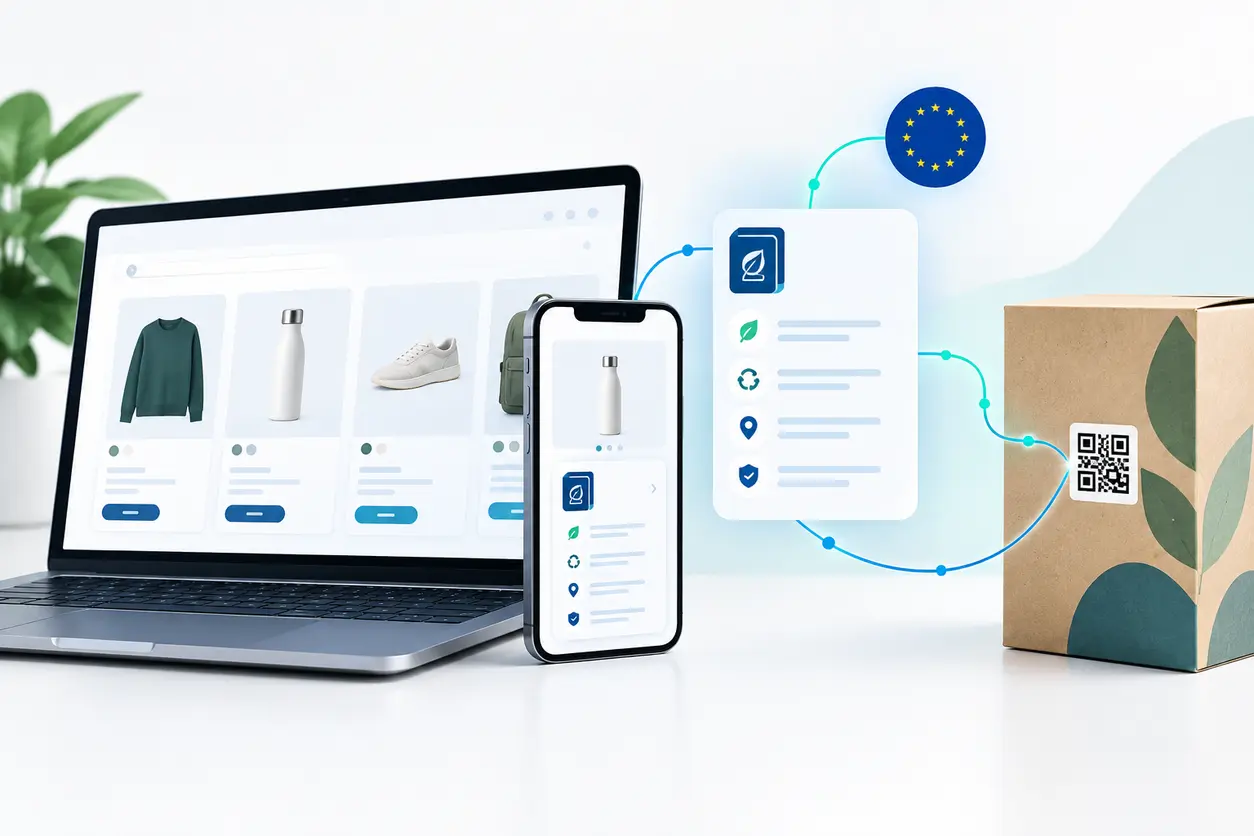
The Commission describes DPP information as accessible online as well as through a product data carrier in its textile and apparel guidance. Fashion teams should therefore plan both routes instead of treating a garment label as the entire access strategy.
On an apparel product page, provide a clearly named, clickable product-information or passport link. A QR image alone is awkward when the shopper is already viewing the listing on a phone.
Keep the online link tied to the selected garment variant. If a colourway or production version has different materials, the page should not silently show another version's record. Where selection is necessary, make that explicit.
The physical and online routes should reach consistent information. Test a customer's journey from a hangtag scan, a sewn-in label scan and an e-commerce link for the same sample garment.
Distinguish physical access from offline access. Scanning an internet-linked QR code does not make the hosted information available without connectivity. For pilots, consider downloadable care and repair guidance, a visible product reference and a support route for connectivity problems. These are usability measures, not a claim that an offline copy meets future legal access requirements.
For wholesale and marketplace distribution, prepare a stable link field that partners can publish without manually inventing their own destination. Keep this focused on garment identity and consistent access rather than building a separate promotional experience for each retailer.
Make supplier changes part of the publishing process
Apparel data changes through substitutions, production corrections, new evidence and supplier updates. A passport pilot needs a change-management process, not just an initial content upload.
Use a simple ownership model:
- Textile suppliers: submit composition and supporting material information.
- Manufacturing teams: identify construction changes and batch associations.
- Sustainability teams: review evidence behind environmental statements.
- Product data teams: maintain identifiers and approved record versions.
- Packaging and label teams: control artwork and production samples.
- E-commerce teams: publish the correct links across listings.
- EU importers and compliance teams: assess applicable responsibilities and unresolved requirements.
Use the Commission's guidance for economic operators as a reference when assessing operator responsibilities; an internal ownership list is not a substitute for determining legal roles.
For each change, require a reason, affected identifiers, supporting evidence, reviewer and effective date. Decide whether it is a correction to an existing record or a different product version that needs a separate association.
Keep supplier evidence and confidential records separate from the public shopper view. Review the final access-rights requirements before deciding what must be public, what belongs in restricted access and what should not be collected at all.
What to prepare in 2026: a fashion readiness checklist
1. Choose a representative pilot capsule
Select garments that expose different operational problems: a simple top, a blended knit and a multi-component outerwear piece, for example. These are illustrative choices, not a regulatory sampling requirement.
Document where each garment is manufactured, how it is labelled, which channels sell it and who controls the supporting records.
2. Audit identifiers and evidence
Map style, colour, size, batch and unit identifiers across your product and manufacturing systems. Identify where the same name means different things to different suppliers.
Create a field inventory with an owner, evidence location and gap status. Do not wait for perfect data before identifying the gaps, but do not publish draft assumptions as verified facts.
3. Reserve label and packaging space
Develop sample layouts for sewn-in labels, hangtags and packaging access points. Leave room for a clear symbol and purpose statement.
Make the layouts adjustable. Avoid large production commitments that assume an unconfirmed carrier size, location or identifier format.
4. Establish a stable access route
Choose who owns the encoded address and who maintains the destination. Record the mapping between garment identity, QR asset and passport pilot page.
Use QR Rapid to generate sample QR codes for approved destinations, then test the resulting printed assets. Keep regulatory and data validation separate from QR creation.
5. Connect the online product page
Add a clickable access link and verify variant mapping. Give wholesale and retail partners the same authoritative destination where appropriate.
Check how the link behaves when a garment is sold out, returned or discontinued. Removing the sales listing should not automatically remove the information route.
6. Test physical and digital access together
Scan production-representative samples on different phones, in ordinary shop lighting and after representative handling or care trials appropriate to the label. Record failures and revise the design.
Test mobile page loading, language selection, broken destinations and wrong-product mappings. Include a simulated website migration or destination replacement in the pilot.
7. Define the release gate
Require sign-off for product identity, evidence, page content, QR destination, artwork and online links before release. Name the person responsible for resolving discrepancies.
Maintain an open requirements register for delegated-act developments and registry-related implementation questions. Revisit the pilot when authoritative details change rather than claiming it is already compliant.
Mistakes to avoid before scaling
The most expensive mistakes are often identity and governance errors rather than unattractive QR design.
Do not send every garment to a generic sustainability page. Do not attach one composition statement to every variant without checking it. Do not let a removable hangtag become the only planned long-term access point. Do not allow a marketing redirect to overwrite the underlying product association.
Also separate usability measurement from compliance evidence. Scan counts can help reveal whether shoppers notice a label, where your selected setup supports tracking. They do not prove that composition is correct, required fields are complete or the code remains readable throughout garment use.
Finally, avoid presenting a pilot as an official or certified EU passport without a verified basis. Clear language such as product-information pilot keeps the work useful while acknowledging the unresolved specification.
Start with a garment access pilot, not a compliance promise
The practical next step is to connect a small garment range to controlled product records, test real labels and establish who approves changes. That work helps uncover supplier gaps, fragile destinations and variant mismatches before scaling.
Use QR Rapid to create and customize pilot QR codes for your approved garment information pages. Keep the designs scan-friendly, preserve the identity-to-destination mapping and verify any management or tracking features you plan to use.
A strong textile DPP preparation programme combines accessible garment information with evidence, continuity and ownership. The QR code opens the door; the quality of the record and the process behind it determine whether that door remains useful.
FAQ
Does the indicative 2027 textile DPP timeline mean every garment needs a passport that year?
Do not treat the indicative category timeline as a universal application deadline. Confirm product scope, application dates and any transition arrangements in the final textile-specific delegated act. Follow the Commission's textile and apparel guidance for developments.
Should a textile digital product passport QR code go on a sewn-in label or a hangtag?
Test both while awaiting final placement requirements. A sewn-in label supports post-purchase access; a hangtag offers visibility before purchase but is removable. Do not assume either placement, or packaging alone, satisfies the eventual rules.
What garment information should suppliers prepare first?
Start with component-level fibre composition, material references, batch associations and supporting evidence. Then organize substantiated durability and sustainability information plus garment-specific repair and recycling guidance. This is a preparation inventory, not a confirmed mandatory field list.
Can the same passport link be used on a garment and its online listing?
Yes, a shared authoritative destination is a practical pilot design if both routes identify the same garment version. Provide a clickable link online rather than relying only on a QR image, and test colour, size and production-version mappings.
Will a garment QR code work without internet access?
A QR code linking to a hosted passport page generally needs connectivity to retrieve that page. Downloadable care guidance and a visible product reference can help users, but should not be described as automatically satisfying future offline-access requirements.
Does using QR Rapid make a textile passport compliant?
No. QR Rapid can help create QR codes for approved destinations, but QR generation does not validate passport data, legal responsibilities, registry integration or final textile requirements. Review those separately and verify the product features needed for your access workflow.
Similar Blogs
The latest industry news, interviews, technologies, and resources.

Join 2,000+ subscribers
Stay in the loop with everything you need to know.
We care about your data in our privacy policy