
Dynamic QR Platform
Create QR codes Instantly
Website URL
Send users to any webpage
Website URL
Website URL
Send users to any webpage
Wi-Fi
Let users connect instantly
Wi-Fi
Wi-Fi
Let users connect instantly
Menu
Create a digital menu
Menu
Menu
Create a digital menu
Start a chat with one tap
Start a chat with one tap
Image
Showcase visuals
Image
Image
Showcase visuals
Show a downloadable file
Show a downloadable file
27 Jun 2026 • 11 min read
QR Codes for Real Estate Open Houses and Property Flyers
A practical guide for agents and property marketers using QR codes on open house signs, listing flyers, yard signs, and brochures to share tours, photos, contact pages, and showing forms while tracking which placements generate the most engagement.
IntroductionWhy real estate QR codes work so wellWhat should a real estate QR code link to?Use real estate QR codes on open house signsUse real estate QR codes on listing flyersUse real estate QR codes on yard signsUse real estate QR codes on property brochuresDynamic QR codes are the real operational advantageHow to track which properties and placements drive engagementSetup checklist for agents and brokersCommon mistakes to avoidChoosing the right real estate QR code workflowTurn printed property marketing into a measurable channelFAQ
That is exactly where real estate QR codes are useful.
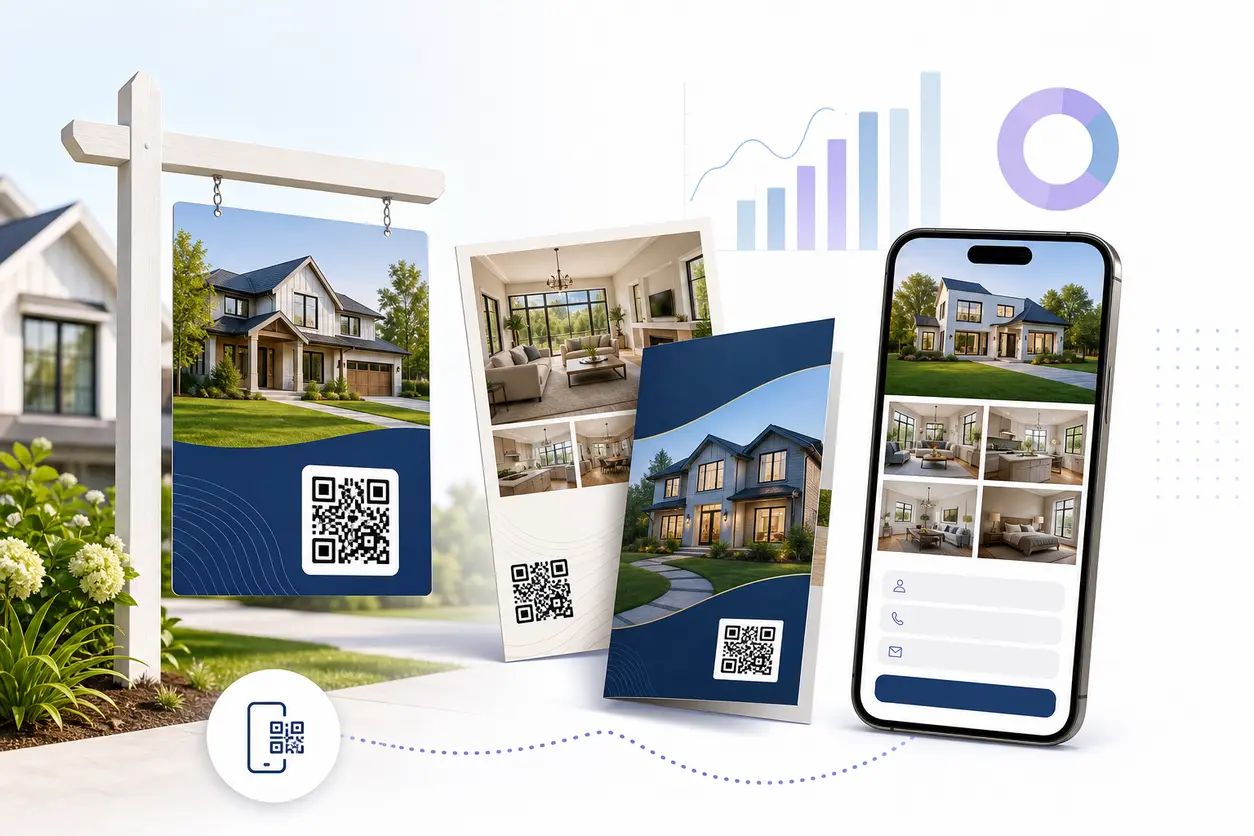
A well-placed QR code turns a sign or flyer into a mobile entry point for the next step: photo gallery, virtual tour, full listing details, agent contact page, or a request-a-showing form. Instead of hoping someone remembers a URL later, you give them a fast path from curbside interest to a tracked action.
For agents, brokers, and property marketers, the real value is not just convenience. It is workflow. With dynamic QR codes, you can update where a code sends people after the sign is already printed, which matters when open house times change, a home goes under contract, or you want to redirect interest to a backup listing.
QR Rapid fits this use case well because it lets teams create dynamic QR codes, organize campaigns by property or placement, and keep printed materials useful even as listing details change.
Why real estate QR codes work so well
Most property marketing starts offline and finishes on a phone. A buyer sees a sign while driving, picks up a flyer in a brochure box, or walks through an open house with a printed handout. In each case, the buyer wants more information than the printed piece can hold.
Real estate QR codes reduce that friction by connecting print to mobile content instantly.
They are especially useful because they help with four common problems:
- Limited print space: A flyer can only show so much before it becomes cluttered.
- Fast-changing listing details: Status, price, open house times, and showing instructions change often.
- Lead capture gaps: Interest is easy to lose if the next step is not immediate.
- Weak attribution: Without separate codes, it is hard to tell whether the yard sign, flyer, brochure, or open house handout drove the inquiry.
The best approach is not to place the same QR code everywhere without a plan. It is to map each printed asset to a specific intent and then track it.
What should a real estate QR code link to?
Before you generate anything, decide what action matters most for that placement.
Best destinations by marketing asset
| Placement | Best QR destination | Primary goal |
|---|---|---|
| Yard sign | Mobile listing page or property landing page | Capture immediate curbside interest |
| Open house sign-in area | Request-a-showing or registration form | Collect buyer leads |
| Property flyer | Photo gallery plus key details | Extend interest after pickup |
| Property brochure | Full landing page with tour, specs, and contact options | Support deeper consideration |
| Window sign | Virtual tour or listing highlights page | Reach passersby after hours |
| Directional open house sign | Event details page with time and map | Increase attendance |
A good rule is simple: link each code to the next logical step, not to the most generic page you have.
Use real estate QR codes on open house signs
Open houses are high-intent moments, but they are also chaotic. Buyers are moving quickly, comparing several homes, and often sharing links with a partner or family member who is not there.
A QR code on open house signage should help visitors do one of three things:
- Open the listing on their phone
- Save the property details for later
- Request a private showing or contact the agent
Practical open house placements
- A large QR code on the main sign rider
- A code at the front door for late arrivals
- A code on the kitchen counter next to printed feature sheets
- A code near the exit with a clear call to action such as "Request a private showing"
What to link during an open house
The most effective destination is usually a simple mobile landing page that includes:
- Property photos
- Price and core specs
- Virtual tour link
- Neighborhood highlights
- Agent contact buttons
- A short showing request form
This keeps the buyer in one flow instead of bouncing between the MLS, a form tool, and a contact page.
With QR Rapid, you can create a dynamic code for the open house sign and update the destination later. If the event time changes, the code can point to revised details. If the property moves under contract, you can redirect that same printed sign code to a "similar homes" page or a backup inquiry form instead of wasting future scans.
Use real estate QR codes on listing flyers
Flyers are often picked up quickly and reviewed later. That means the QR code should work as a bridge from brief printed information to richer mobile content.
What works best on flyers
For most listings, the flyer QR code should open a page with:
- Full photo gallery
- Floor plan if available
- Virtual walkthrough
- Property details not included on the flyer
- Financing or affordability notes if relevant
- Contact options for questions or showings
This is especially useful for properties with strong visual appeal. Instead of squeezing twelve photos into a one-page flyer, you can keep the flyer clean and send buyers to the full gallery.
Example flyer workflow
Imagine a two-sided flyer for a new listing.
- Front side: hero photo, address, price, bed and bath count, standout features
- Back side: neighborhood summary, agent details, and a QR code labeled "See all photos and schedule a tour"
That call to action is stronger than a generic "Scan me" because it tells the buyer exactly what happens next.
If you are running multiple flyer versions, create separate dynamic codes for each distribution point. For example:
- Flyer in brochure box
- Flyer handed out at open house
- Flyer placed in local business display
That gives you better scan attribution without changing your overall listing page.
Use real estate QR codes on yard signs
Yard signs capture the highest curiosity at the earliest moment. Someone sees the home in person, likes the street, and wants details right away.
That means the yard sign QR code has one job: get the buyer from curb to property page fast.
Yard sign best practices
- Use a short instruction such as "Scan for price, photos, and tour"
- Keep the QR code large enough to scan from a safe standing distance
- Place it where glare, bolts, or edges will not interfere
- Send users to a mobile-optimized page, not a desktop-heavy PDF
What not to do
Do not send yard sign traffic to a generic homepage or office website. Buyers scanning from the curb want this property first. If they have to search again, you will lose them.
A better setup is a dynamic property page that can be updated as the listing changes. If the home sells, you do not need to replace the sign immediately. You can update the QR destination in QR Rapid to show:
- Under contract status
- Final open house cancellation notice
- Similar nearby listings
- Agent contact page for new inventory alerts
That is one of the clearest business cases for dynamic real estate QR codes. Your printed sign keeps working even when the listing changes.
Use real estate QR codes on property brochures
Brochures are different from flyers because they support deeper consideration. They are often used in luxury listings, new developments, model homes, multifamily leasing, and investor presentations.
A brochure QR code can handle richer destinations, such as:
- Full feature library
- Video walkthrough
- Downloadable floor plans
- Community amenities page
- Builder specifications
- Appointment request form
Brochure strategy that converts better
Instead of using one brochure code for everything, consider using different codes by spread or section.
For example:
- Code on cover: full listing overview
- Code on amenity page: neighborhood or community gallery
- Code on floor plan page: schedule a tour
- Code on back cover: contact the agent
This makes the brochure interactive and also helps you see which part of the sales story creates the most engagement.
Dynamic QR codes are the real operational advantage
Static codes are fine for information that never changes. Property marketing is not that.
Listings change constantly:
- Open house dates move
- Prices drop
- Status changes to under contract or sold
- Photo galleries get updated
- Forms change by team or market
- Agents want to reroute traffic to a new campaign
Dynamic real estate QR codes solve this because the printed code stays the same while the destination changes behind it.
Real estate use cases where dynamic matters most
#### 1. Open house details change after signs are printed
Update the destination page instead of reprinting directional signs and flyers.
#### 2. A property goes under contract
Redirect scans to a waitlist form, similar homes page, or the agent's active listings.
#### 3. A brochure is reused across a development phase
Swap the destination from one available unit to another while keeping the same printed materials in circulation.
#### 4. A team wants one sign system across many listings
Use dynamic codes organized by property so each code can be reassigned cleanly when inventory changes.
QR Rapid is particularly useful here because teams can keep the code live, update the destination quickly, and avoid wasting printed inventory every time a listing changes.
How to track which properties and placements drive engagement
A big missed opportunity in print marketing is attribution. If all your signs and flyers use the same code, you will know that scans happened, but not what created them.
A better system is to create separate QR codes by both property and placement.
Recommended naming structure
Use a simple naming format such as:
- 18-maple-st-yard-sign
- 18-maple-st-open-house-entry
- 18-maple-st-flyer-box
- 18-maple-st-brochure-back-cover
This lets you compare interest across placements for the same listing.
What you can learn from separate codes
- Which listings generate the most offline engagement
- Whether yard signs outperform printed flyers
- Whether open house visitors scan at entry or exit
- Which brochure sections lead to the most follow-up action
- Which campaigns should get more print budget next month
A practical attribution example
Suppose one property gets:
- Many scans from the yard sign
- Moderate scans from the brochure
- Very few scans from the flyer box
That tells you the curb appeal is working, but the flyer pickup or flyer call to action may need improvement. You might test a new flyer headline, larger code placement, or stronger action like "Book a 15-minute tour" instead of "More details."
That kind of optimization is much harder when every printed item shares one undifferentiated QR code.
Setup checklist for agents and brokers
If you want a real estate QR code workflow that is easy to manage, use this order:
1. Pick one mobile destination per asset
Do not make buyers guess. Match each printed item to one clear action.
2. Use dynamic codes for active listings
Anything tied to price, status, timing, or inventory should be dynamic.
3. Create separate codes by placement
Track yard signs, flyers, brochures, and open house materials independently.
4. Write the call to action next to the code
Use outcome-based text such as:
- See photos and price
- Take the virtual tour
- Request a private showing
- Get full property details
5. Test every code on mobile before printing
Check speed, readability, and whether the page matches the promise on the sign or flyer.
6. Review scan performance weekly
Use scan data to decide which listings, placements, and printed materials deserve more investment.
Common mistakes to avoid
Even good-looking property materials can underperform if the QR flow is weak.
Avoid these mistakes:
- Linking every code to the homepage
- Using static codes for active listings
- Printing tiny codes on busy backgrounds
- Offering no clear reason to scan
- Sending users to pages that are slow or hard to read on mobile
- Reusing one code across every placement when attribution matters
Choosing the right real estate QR code workflow
If your goal is simple visibility, one code per listing may be enough.
If your goal is better lead capture and attribution, use this structure instead:
- One dynamic destination per listing
- Multiple QR codes per listing based on placement
- One clear call to action per printed asset
- Regular updates as listing status changes
That workflow keeps marketing agile without forcing constant reprints.
Turn printed property marketing into a measurable channel
Real estate QR codes work best when they are treated as part of the listing workflow, not as a decorative add-on. The code on a yard sign should capture curbside interest. The code on a flyer should extend engagement. The code at an open house should move a visitor toward a showing request. The code in a brochure should deepen consideration.
When those codes are dynamic and trackable, your print materials stop being static collateral and start acting like measurable campaign assets.
If you want a faster way to build that system, QR Rapid helps you create dynamic QR codes for listings, update destinations without reprinting, and organize scans by property and placement. For agents and teams juggling open houses, brochure boxes, and changing inventory, that flexibility is the difference between a code that merely exists and a code that actually drives inquiries.
Create your next listing workflow in QR Rapid and make every sign, flyer, and brochure easier to scan, easier to update, and easier to measure.
FAQ
What should real estate QR codes link to on a yard sign?
A yard sign QR code should usually link to a mobile-friendly property page with price, photos, basic specs, and a clear contact or showing option. Avoid sending scans to a generic homepage.
Should I use the same QR code on signs, flyers, and brochures for one listing?
Not if you want attribution. Use separate QR codes for each placement so you can see whether the yard sign, flyer box, open house handout, or brochure generated the scan.
Why are dynamic QR codes better for real estate listings?
Dynamic QR codes let you change the destination after printing. That is useful when open house details change, a home goes under contract, or you want to redirect traffic to similar listings.
Where should I place a QR code on an open house sign?
Use a visible, easy-to-scan placement near the main property details or on a rider with a clear call to action such as seeing photos, getting details, or requesting a private showing.
Can I reuse a real estate QR code after a property sells?
Yes, if it is dynamic. You can keep the printed code active and update it to point to similar homes, an agent contact page, or a waitlist form instead of the sold listing.
What is the best call to action next to a property flyer QR code?
Be specific about the result. Phrases like "See all photos," "Take the virtual tour," or "Request a showing" usually perform better than a generic "Scan me."
Similar Blogs
The latest industry news, interviews, technologies, and resources.
 June 16, 2026
QR Codes for Event Sponsorship Booths and Sponsor Lead Capture
QR Codes for Event Sponsorship Booths and Sponsor Lead Capture
Read post
 June 15, 2026
QR Codes for Contractors: Estimate Requests, Job Site Updates, and Review Collection
QR Codes for Contractors: Estimate Requests, Job Site Updates, and Review Collection
Read post
Join 2,000+ subscribers
Stay in the loop with everything you need to know.
We care about your data in our privacy policy