
Dynamic QR Platform
Create QR codes Instantly
Website URL
Send users to any webpage
Website URL
Website URL
Send users to any webpage
Wi-Fi
Let users connect instantly
Wi-Fi
Wi-Fi
Let users connect instantly
Menu
Create a digital menu
Menu
Menu
Create a digital menu
Start a chat with one tap
Start a chat with one tap
Image
Showcase visuals
Image
Image
Showcase visuals
Show a downloadable file
Show a downloadable file
29 Sep 2026 • 14 min read
Permanent Magnet Product Passports Under the EU Critical Raw Materials Act: QR and Data-Carrier Readiness
A permanent-magnet-specific guide to the EU Critical Raw Materials Act data-carrier rules, required information, QR code implementation, and durable passport architecture.

IntroductionWhich products are in scope?What information must be available through the data carrier?Effective dates: plan now, but distinguish the rule from its application dateWhy a QR code is a practical 2D data carrierBuild the identifier and data architecture before generating codesPhysical marking: make the code survive the product lifecycleStatic versus dynamic QR codes for CRMA readinessA rollout workflow for manufacturers and suppliersCommon implementation mistakesA practical next stepFAQ
For manufacturers of motors, drives, electronics and industrial equipment, a permanent magnet product passport QR code is best understood as an access point to regulated product information—not simply a label or marketing destination.
Regulation (EU) 2024/1252, the Critical Raw Materials Act (CRMA), introduces information requirements for specified products that contain permanent magnets. The purpose is practical circularity: parties handling a product later in its life should be able to identify the magnet, understand where it is installed, and access the information needed to remove and recover it.
The Regulation does not mandate QR codes alone. It requires a data carrier linked to a unique product identifier. Under the CRMA text, a data carrier may be a linear barcode, a two-dimensional symbol, or another automatic-identification medium that can be read by a device. A website URL QR code is therefore a strong implementation option, particularly where the operator needs a human-readable, smartphone-scannable path to detailed and updateable information.
This article focuses specifically on covered permanent-magnet products under the CRMA. It is not a battery passport guide, a general electronics passport guide, or a claim that every product containing a magnet immediately needs a passport.
Which products are in scope?
The CRMA permanent-magnet provisions apply to products placed on the EU market that incorporate one or more permanent magnets and fall within the product categories specified in the Regulation. In broad operational terms, the listed categories include:
- Certain wind-energy generators
- Motor vehicles in relevant categories
- Light means of transport
- Cooling appliances
- Heat pumps
- Electric motors, including where installed in other products
- Automatic washing machines and washer-dryers
- Tumble dryers
- Microwaves
- Vacuum cleaners
- Dishwashers
The exact scope depends on the Regulation’s legal definitions, product categories and exclusions. A compliance team should assess the actual finished product and CN-code-related framing in the legislative text, rather than assuming that every component or every magnetic assembly is automatically covered.
A useful supply-chain rule is to map the finished product first, then map each permanent magnet within it. That prevents two common errors: building a product-page QR code for equipment that is not within the listed scope, or overlooking a covered motor incorporated into a larger product.
What information must be available through the data carrier?
For covered products, Article 27 of the Critical Raw Materials Act requires the data carrier to give access to information relating to the permanent magnets incorporated in the product. The information must include the following categories.
Identity of the responsible operator
The information should identify the responsible economic operator. For an implementation team, this means maintaining a controlled legal-entity record rather than relying on a distributor name copied into a product brochure.
Typical fields may include:
- Responsible operator name
- Registered address and appropriate contact route
- Role in the supply chain, such as manufacturer or authorised representative where relevant
- Product or model reference connected to the identifier
This information needs governance. A change in corporate address, EU representative or support route should be publishable without changing the physical identifier already attached to products in the field.
Magnet weight and location
The passport information must describe the weight of each individual permanent magnet, or where the magnets are not easily accessible, the combined weight of the permanent magnets. It must also state the location of the magnets in the product.
For a motor manufacturer, location information should be specific enough to support service and recovery work. “Inside motor” is unlikely to be as useful as a structured location such as:
- Drive motor assembly
- Rotor, behind end shield
- Magnet type and quantity per rotor
- Access route after removal of the motor from the appliance
For a heat-pump unit, a record could distinguish a compressor motor magnet from a fan motor magnet. For an EV supplier, it could identify the traction-motor rotor and relate it to a serviceable assembly reference.
Magnet composition
The CRMA requires information on whether the magnet contains one or more of neodymium, praseodymium, dysprosium or terbium. Where applicable, it also requires the share by weight of those materials within the magnet.
This is a data-quality challenge as much as a publishing task. Composition records may originate with magnet suppliers, while the finished-product manufacturer controls the data carrier and the product-level experience. Establish supplier declarations, version-controlled specifications and a procedure for managing changes in approved magnet formulations.
Presence and share of recycled content
Where relevant, the information must cover the presence and share of recycled neodymium, praseodymium, dysprosium and terbium in the permanent magnets. Do not treat this as an estimated sustainability statement. The record should be traceable to the substantiation and calculation method maintained by the responsible organization.
Keep the externally accessible claim concise, but preserve evidence internally: supplier documentation, batch linkage, mass-balance decisions where applicable, approval records and data-owner sign-off.
Removal, dismantling and disposal guidance
The data carrier must provide information enabling the removal of the permanent magnets from the product. Where possible, it must include instructions for dismantling, dismantling sequences or the information needed to access the magnets, together with handling considerations for end-of-life treatment.
This is where the product passport becomes operationally valuable. A recycler does not need a marketing description of rare-earth magnets. They need a reliable path to identify the product, locate the magnet, understand access constraints, and reach the relevant removal guidance.
Use audience-specific layers. A public landing page can provide basic product and operator information, while a verified professional route can offer controlled technical documentation where appropriate. The CRMA does not turn proprietary design details into marketing content; teams should have legal and technical owners decide the appropriate depth of disclosure.
Effective dates: plan now, but distinguish the rule from its application date
The CRMA entered into force on 23 May 2024. However, the permanent-magnet data-carrier obligations do not apply immediately to all products. Article 27 provides that the data-carrier requirements apply from 24 months after the date of entry into force of the relevant delegated act adopted by the Commission for the products concerned.
That distinction matters:
- The CRMA is already in force.
- Article 27 establishes the product-information and data-carrier framework.
- A delegated act is needed to specify the covered product categories and detailed requirements.
- The obligation then starts 24 months after that delegated act enters into force.
Do not use a generic “CRMA deadline” in packaging specifications or supplier contracts without checking the current legal status of the relevant delegated act. The official Regulation is the primary source for the framework and timing mechanism. Your regulatory team should monitor Commission activity, confirm product scope, and document the final applicability date for each affected product family.
Why a QR code is a practical 2D data carrier
A QR code can meet the functional idea of a two-dimensional machine-readable symbol when deployed as part of a compliant data architecture. It is not inherently compliant because it is a QR code; the destination, identifier, available information, durability and operating process matter just as much.
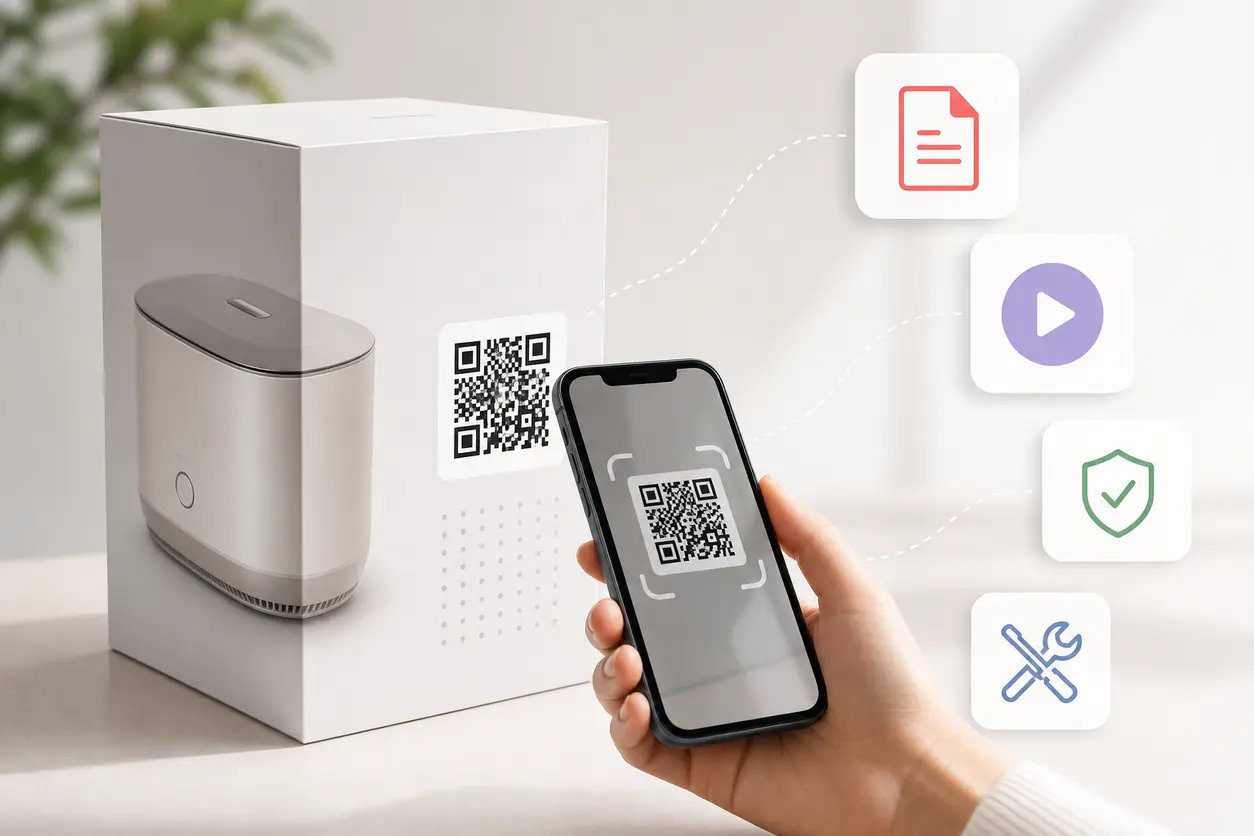
A QR-based approach is particularly useful when the information must remain available beyond the point of sale and change over the product lifecycle. For example, a product’s verified removal guide may need a controlled update after a service bulletin, while the physical marking on a motor, appliance or equipment enclosure remains unchanged.
A well-designed QR route can support:
- Smartphone access for service technicians and recyclers
- Scanner-based retrieval in receiving or dismantling workflows
- A persistent unique product or model identifier
- Automatic routing to the correct document version
- Separate views for public, professional and authenticated users
- Retrieval of archived records for discontinued product ranges
Other permissible carriers may make sense in particular environments. A linear barcode may integrate with a legacy factory workflow. RFID or another automatic-identification method may help in closed-loop industrial systems. The decision should reflect the product, operating environment, user equipment, cost, marking area and expected service life. Avoid writing a requirement that says “QR only” unless a separate company rule justifies that decision.
Build the identifier and data architecture before generating codes
The code graphic is the final visible element of a larger system. Start with product identity and data governance.
1. Decide the identification level
Choose whether the permanent-magnet record is held at model, configuration, batch or serialized-unit level.
A model-level record may suit a stable appliance design with uniform magnet content and removal instructions. A configuration-level or serial-level record may be safer when motor variants, magnet sourcing, recycled-content declarations or service instructions differ within a product family.
The critical test is simple: can the scanned identifier return accurate information for the physical product in front of the user?
2. Use a persistent identifier, not a file name
A PDF filename such as motor-guide-final-v6.pdf is not a durable product identity. Give each record a persistent identifier with clear ownership rules. It may be an internal immutable ID, a URI-based identifier or an identifier linked to an established enterprise numbering scheme.
Keep the identifier independent from short-lived marketing platforms, individual staff accounts and temporary campaign URLs. The data carrier should resolve reliably for the expected service and end-of-life period of the product.
3. Separate identifier, resolver and content
A resilient architecture has three layers:
- Identifier: the stable reference assigned to the product, configuration or unit.
- Resolver: the controlled URL or service that translates the identifier into the correct current record.
- Content: the structured record, technical guidance and supporting documents users can access.
Separating these layers lets a manufacturer change hosting, improve the information structure or update a controlled instruction without replacing every physical code. It also avoids hard-coding a transient PDF link into a permanent machine label.
4. Create a minimum data model
Before rolling out labels, agree on the fields the passport must retrieve. At a minimum, plan for:
- Unique product identifier
- Product family, model and configuration identifiers
- Responsible operator details
- Magnet count or grouping logic
- Magnet location and weight information
- Presence and share by weight of relevant rare-earth elements where required
- Recycled-content information where required
- Removal, dismantling and disposal guidance
- Document version, publication date and change history
- Language and market applicability
- Source-system reference and accountable data owner
Treat each field as a governed record, not free text pasted into a webpage. This is especially important when engineering, procurement, sustainability, regulatory and after-sales teams contribute different parts of the record.
5. Make access usable for lifecycle actors
The same scanned code may be used by a field technician, a dismantler, a recycler, a compliance auditor or a customer. Design the initial page around the most urgent action: identify the product and find the magnet guidance.
A sensible landing sequence is:
- Confirm product identity and current record status.
- Display the responsible operator.
- Present a clear magnet summary: number or grouping, location and relevant material data.
- Link directly to removal and dismantling guidance.
- Offer downloadable controlled documents where that is appropriate.
- Provide a route to report a record mismatch or request support.
The European Commission’s Digital Product Passport guidance for economic operators is useful context for building data access and operator responsibilities, but teams should keep the CRMA’s permanent-magnet-specific rules separate from broader DPP discussions.
Physical marking: make the code survive the product lifecycle
A technically correct URL is of little value if the label becomes unreadable before a recycler sees it. Choose placement and marking methods based on the product’s likely lifecycle conditions.
For example:
- Put the code on a durable rating plate, casing or accessible equipment label rather than on disposable transit packaging.
- Avoid curved, highly textured, heat-exposed or abrasion-prone locations when a flatter protected area is available.
- Ensure the label remains accessible after normal installation where possible.
- Maintain adequate contrast, quiet zone and print quality.
- Test scanning with the actual label material, curvature, surface finish, lighting and likely mobile devices.
- Define a fallback path, such as a human-readable short identifier, for a damaged or inaccessible symbol.
For products where a magnet is in a sealed or internal motor, do not place the only data carrier on a removable carton. Put it on the finished product or durable assembly in line with the applicable requirements and the real recovery workflow.
Static versus dynamic QR codes for CRMA readiness
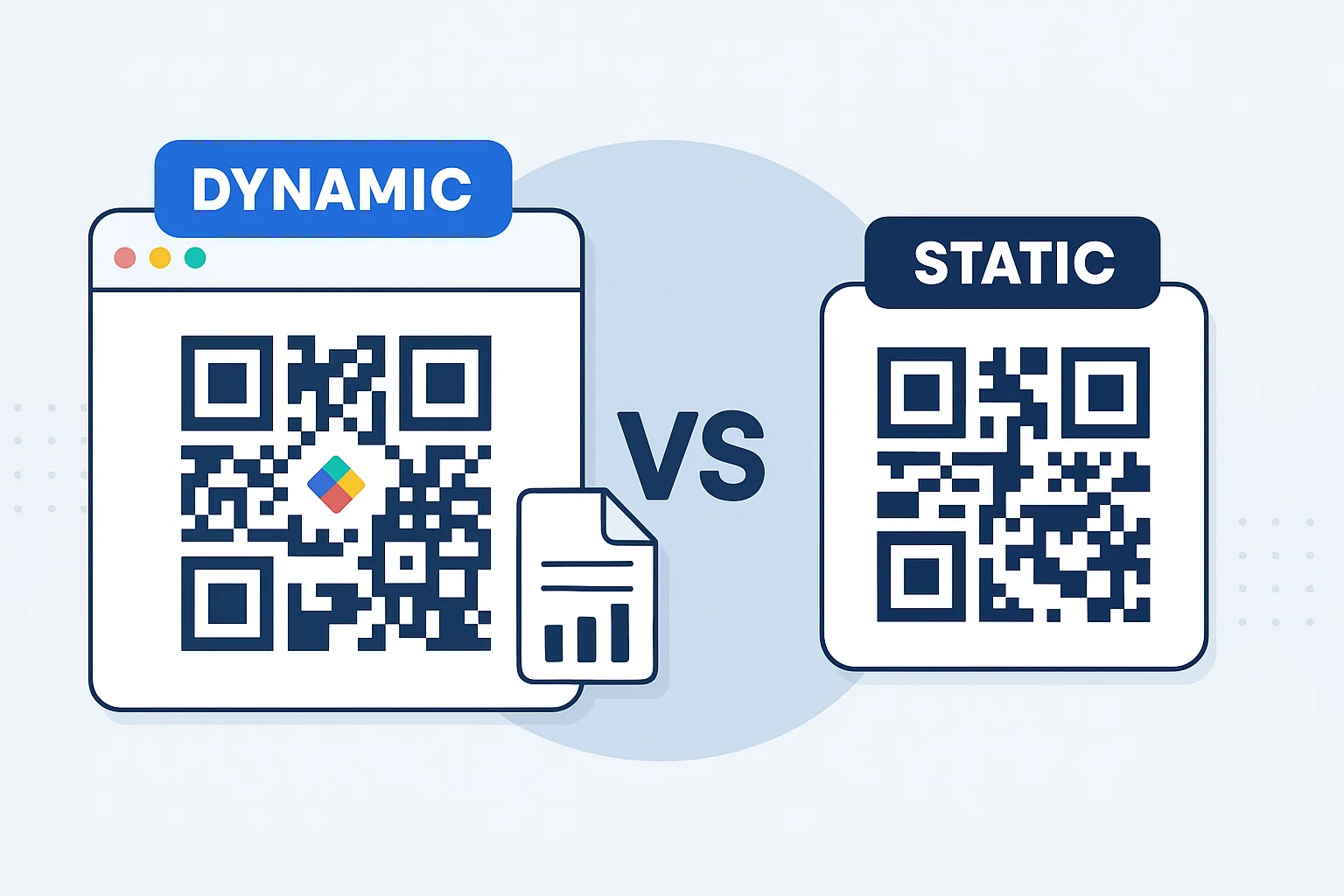
A static QR code directly encodes the final destination. It can be suitable when the destination is truly permanent and its content will never need to move or change. For CRMA readiness, that is a narrow use case.
A managed, dynamic QR code uses a stable scan destination that can be redirected to the current controlled product record. This approach can be useful when you need to:
- Move documentation to a new domain or repository
- Correct a link without changing a physical marking
- Publish an approved revision of removal guidance
- Segment access by product configuration or audience
- Monitor whether field labels can still be scanned
Dynamic routing is not a substitute for document control or legal review. Every material change to a permanent-magnet record needs an owner, an approval path, a version history and an assessment of whether the physical product identifier still resolves to accurate information.
QR Rapid can help teams create consistent QR code artwork that directs users to controlled permanent-magnet passport URLs. Use it after your organization has defined the identifier pattern, record owner, landing-page governance and label placement specification. For multi-product programs, maintain an internal register that maps each QR Rapid code to the corresponding product identifier, product configuration and approved destination.
A rollout workflow for manufacturers and suppliers
Start with a scoped product inventory
List EU-bound product families that may fall under Article 27. Include finished goods, incorporated motors and variant-level designs. Record why each family is in scope, out of scope or awaiting review.
Map magnet data back to suppliers
Ask magnet and motor suppliers for structured information, not just brochure PDFs. Specify fields, units, update obligations, evidence expectations and how a supplier must notify you of composition or sourcing changes.
Reconcile engineering, service and compliance records
Engineering drawings may show magnet position, procurement systems may hold composition data, and after-sales teams may own removal procedures. Reconcile them before publishing. Contradictions should be resolved by designated technical and regulatory owners.
Define the product record and approval process
Set who can create, amend, approve and retire a passport record. Preserve previous versions and make sure a user can identify the applicable revision. Build a process for recalls, service notices, product discontinuation and corporate-operator changes.
Pilot the physical carrier in realistic conditions
Run scans on production samples and installed equipment. Include dirty surfaces, glare, distance, low battery devices and the access conditions likely at an end-of-life facility. Test both the QR code and the human-readable fallback identifier.
Operate it as a long-lived compliance service
Assign an ongoing owner. Monitor failed URLs, expired certificates, host migrations, discontinued product records and support tickets. A code that worked at launch but resolves nowhere years later undermines the very recovery objective it was intended to support.
Common implementation mistakes
Treating the QR code as the compliance project
The symbol is only the retrieval mechanism. Compliance readiness depends on scope analysis, accurate data, a unique identifier, access design and reliable lifecycle governance.
Publishing vague location information
“Contains rare-earth magnet” does not help a dismantler locate or access a magnet. Use structured, product-specific locations and link to actionable removal guidance.
Placing a single code on packaging
Transport packaging is frequently separated from the product long before repair or recycling. Design for the person who handles the equipment at end of life.
Encoding unstable file URLs
Hard-coded links to a temporary PDF repository create a future maintenance risk. Use a persistent resolver that can route to a governed current record.
Ignoring variants and supplier changes
A model family can contain different motors, magnet formulations or recycled-content evidence. If the differences matter to required information, the identifier and record structure need to distinguish them.
Assuming a QR code is the only permitted technology
The CRMA allows a linear barcode, two-dimensional symbol or other automatic-identification medium. Select a compliant carrier strategy that suits your operational environment, while recognizing that QR codes are often the most accessible 2D option for cross-lifecycle use.
A practical next step
Begin with one representative EU-bound product family containing permanent magnets. Map the magnet data, identify the correct record level, draft a recycler-first landing page and validate durable physical placement. Then create a QR Rapid code that points to the controlled resolver—not directly to a temporary file.
That pilot will expose the decisions that matter most: where your magnet data actually lives, which variants need their own identifiers, who approves changes, and whether a person at the end of the product’s life can retrieve useful information in seconds. Build those foundations now, while the delegated-act timeline is monitored, rather than treating the permanent magnet product passport QR code as a last-minute label change.
FAQ
Does the EU Critical Raw Materials Act require a QR code for permanent magnets?
No. The CRMA requires a data carrier linked to a unique product identifier for covered products. A data carrier can be a linear barcode, a two-dimensional symbol such as a QR code, or another automatic-identification medium.
When do permanent-magnet data-carrier requirements apply?
The CRMA framework is in force, but Article 27 states that the data-carrier requirements apply 24 months after the relevant Commission delegated act enters into force. Confirm the applicable delegated act and product scope before setting an internal compliance date.
What must a permanent magnet product passport show?
For covered products, the accessible information includes the responsible operator, magnet weight and location, relevant magnet composition, recycled-content information where applicable, and information that enables magnet removal and dismantling.
Should the identifier be model-level or serial-level?
Use the lowest level needed to ensure the scanned record is accurate for the physical product. Stable products may work at model level, while differing motor variants, magnet compositions or recycled-content records may require configuration- or unit-level identification.
Can a QR code link directly to a PDF removal manual?
It can, but a direct PDF link is usually less durable than a persistent resolver page. A resolver can preserve the physical code while routing users to the current approved record, technical documents and version history.
Where should a permanent-magnet data carrier be placed?
Place it on a durable, accessible part of the finished product or relevant long-lived assembly, based on the applicable requirements and recovery workflow. Avoid relying solely on packaging that may be discarded before servicing or recycling.
Similar Blogs
The latest industry news, interviews, technologies, and resources.
 August 7, 2026
QR Codes for Equipment Maintenance Logs: Scan-to-Report Inspections, Repairs, and Service History
QR Codes for Equipment Maintenance Logs: Scan-to-Report Inspections, Repairs, and Service History
Read post
Join 2,000+ subscribers
Stay in the loop with everything you need to know.
We care about your data in our privacy policy